Does switching pay off? The impact of parliamentary party instability on individual electoral performance
Allan Sikk, Sona N. Golder, Raimondas Ibenskas, Paulina Sałek-Lipcean
Abstract
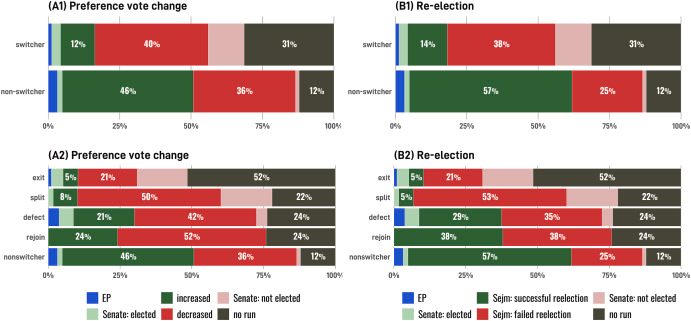
Members of parliament (MP) may change their parliamentary party group (PPG) for a variety of reasons including the desire to improve their electoral prospects. But is changing PPGs associated with better electoral performance and outcomes? We show that switchers generally perform worse than non-switchers, though electoral outcomes for switchers vary depending on the nature of their switch. Using an original dataset on Polish MPs since the early 2000s, we examine how party switching affects their electoral performance in terms of (a) running again, (b) re-election success and (c) personal preference votes. We find that switchers are much less likely to seek reelection compared to non-switchers. Among switchers, those not associated with a PPG at the end of the term are less likely to run again than others. Switching is related to weaker electoral performance and re-election success, but the effect depends on the type of switching. While switching is a risky endeavour, some types of switching are riskier than others.
Link to full text: https://doi.org/10.1016/j.electstud.2025.103037



 Party Instability in Parliaments: INSTAPARTY