All posts by instapartyproject

Article in Legislative Studies Quarterly

Independents in Parliament: Temporary Status or Final Destination?

Raimondas Ibenskas, Paulina Sałek-Lipcean, Sona N. Golder, Allan Sikk

Abstract
Political parties are essential for structuring parliamentary decision-making in democracies. However, in some countries, as many as 10% of legislators experience spells outside of parliamentary party groups. This paper sheds light on this important group of independent politicians by analyzing whether and when they join existing or new party groups. We argue that the electoral motivations of members of parliament (MPs) affect their incentives for reaffiliation. We capture electoral motivations with two factors: the personal vote of legislators and membership in minor parties that do not have their own parliamentary groups. We test this argument using a novel dataset covering over 800 spells of independence and 500 entries into party groups in three Central and Eastern European countries (Lithuania, Poland, and Romania) since the early 2000s. We find that independents affiliated with a minor party are more likely to form a new party group, while MPs with a significant personal vote or those not affiliated with a minor party are more prone to join an existing party group.

Link to full text: https://doi.org/10.1111/lsq.70015

Independence versus Affiliation: What Determines Entry into Parliamentary Party Groups?

Our paper prepared for the APSA 2023 Annual Meeting, Los Angeles

Abstract.

Political parties are often considered essential for structuring parliamentary decision-making in democracies. However, many MPs experience spells of being non-affiliated with any parliamentary party group (PPG), either because they were elected as independent candidates or left their PPGs earlier in the legislative term. Whether such non-affiliation periods end with an entry to a PPG, which PPG the legislator enters and how long they remain independent before the entry, as well as the reasons for these patterns, remains relatively unknown. This paper addresses these under-researched questions by examining PPG entry in three Central and Eastern European countries (Lithuania, Poland, and Romania) in the last two decades. We build and test an argument that electoral, office and policy concerns of both the MPs considering the entry and the potential receiving parties play an important role in driving entry. Our findings suggest that legislators’ electoral incentives as a key explanation for their PPG affiliation decisions.

Does switching pay off? The impact of parliamentary party instability on individual electoral performance

Our paper prepared for the APSA 2023 Annual Meeting

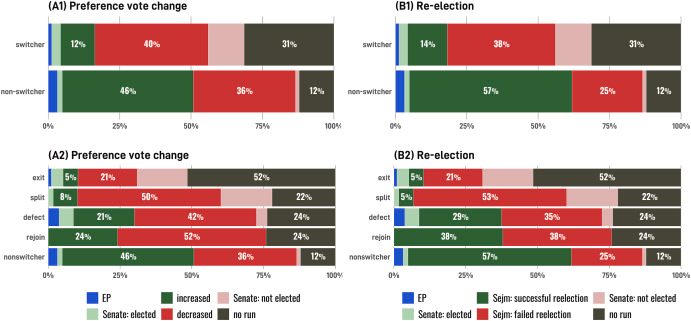
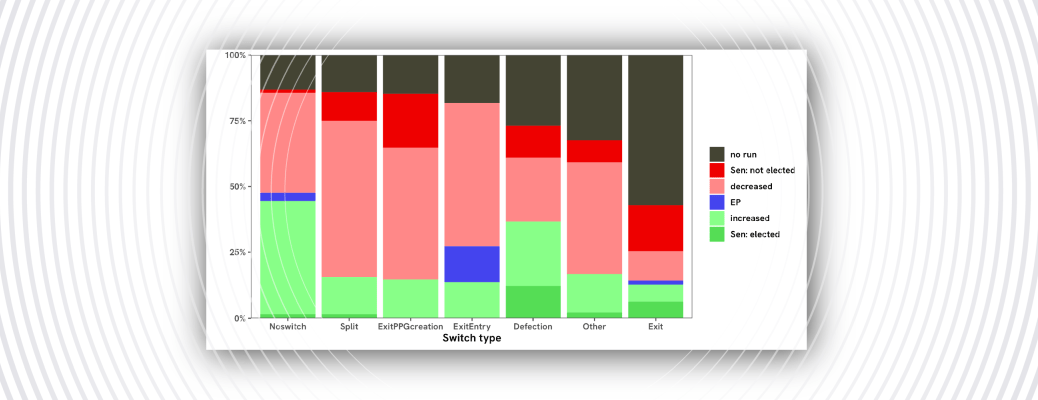
Abstract. Members of parliament who change their parliamentary party group (PPG) affiliation can be motivated by a variety of factors but the desire to improve their electoral prospects is often argued to be the among the most important. But does switching PPG affiliation improve or damage the electoral performance of those involved? We study the changes in electoral performance of Polish MPs involved in parliamentary party instability since mid-1990s using an original dataset on all instances of switching compiled by the INSTAPARTY (Party Instability in Parliaments) project. In addition to analyzing whether the MPs run for the parliament again in the following election, we zoom in on their electoral performance in terms of personal preference votes. We consider the electoral dividends of different types of switching and find that the effect of switching on personal electoral performance depends on the type of switching MPs were involved in.